Attendance Management System: Meaning & Importance
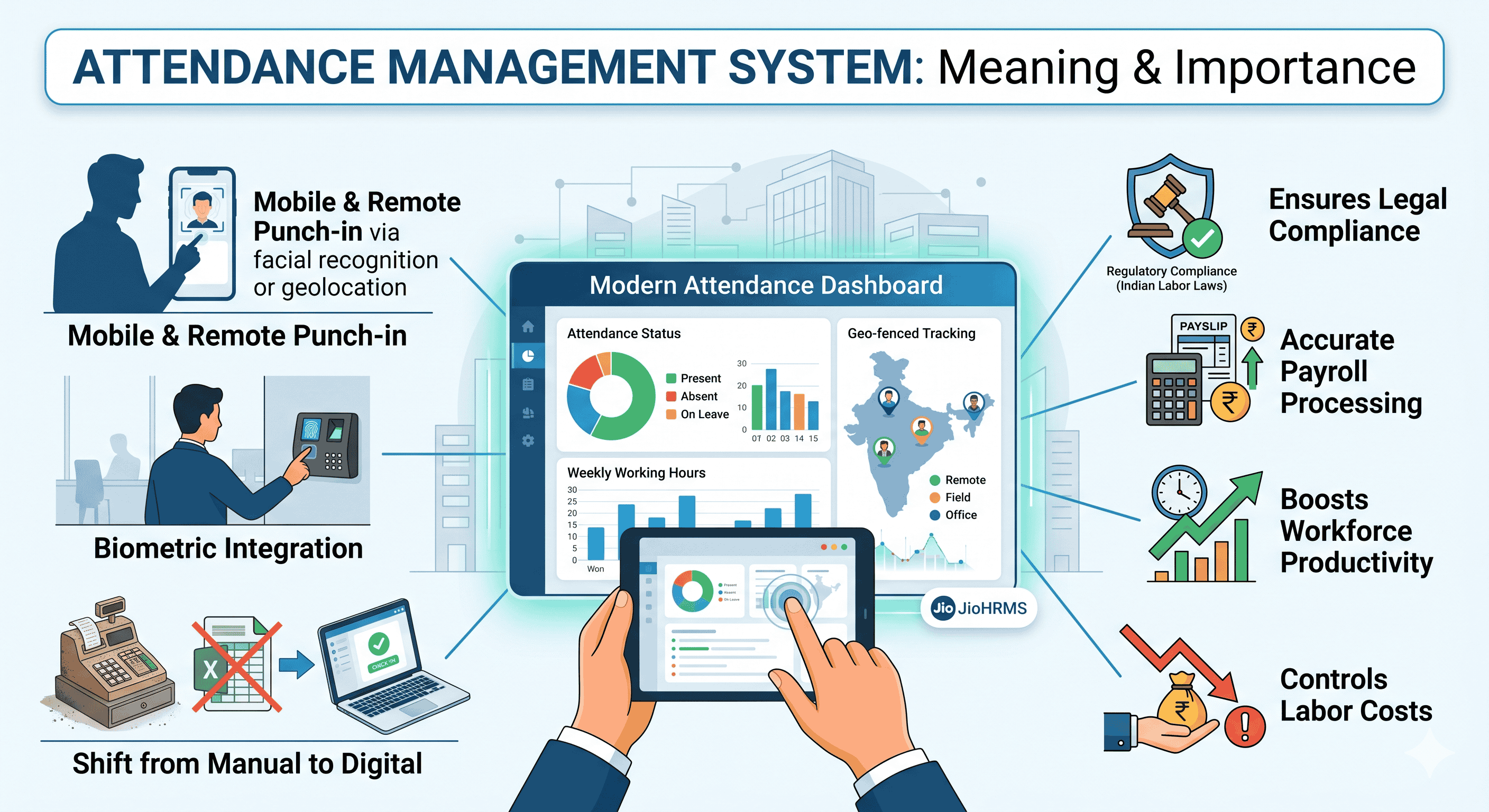
In today’s hyper-competitive business environment, workforce productivity, compliance, and operational efficiency are no longer HR-only concerns. They are boardroom priorities. As organizations scale, adopt hybrid work models, and face tighter regulatory scrutiny, the way employee attendance is tracked and managed has become a strategic lever rather than an administrative task.
This is where an attendance management system plays a critical role.
For CXOs, CHROs, CFOs, and founders, understanding the meaning and importance of an attendance management system is essential to building a resilient, compliant, and future-ready organization. TL;DR
An attendance management system automates employee attendance tracking, time logs, and work hours.
It directly impacts payroll accuracy, compliance, productivity, and cost control.
Manual attendance methods create data gaps, compliance risks, and revenue leakage.
Modern systems support remote, hybrid, and multi-location workforces.
Integration with payroll and HRMS is essential for enterprise scalability.
A robust attendance system enables data-driven workforce decisions.
Platforms like JioHRMS unify attendance, payroll, and compliance seamlessly.
What Is an Attendance Management System?
An attendance management system is a digital framework that records, tracks, validates, and analyzes employee working hours, presence, absences, leaves, and overtime across an organization.
Unlike traditional registers or spreadsheets, a modern attendance system provides real-time visibility, automated rules, and audit-ready records that scale with organizational complexity.
At its core, an attendance management system answers four critical questions for leadership:
Who is working?
When are they working?
Where are they working from?
Are they compliant with organizational and statutory policies?
Evolution of Attendance Management in Modern Enterprises
Attendance management has evolved significantly over the last two decades.
Phase 1: Manual Attendance
Paper registers
Supervisor sign-offs
High error rates
No audit trail
Phase 2: Spreadsheet-Based Tracking
Excel or CSV files
Manual consolidation
Limited scalability
High dependency on HR teams
Phase 3: Digital Attendance Systems
Biometric and mobile attendance
Policy-driven automation
Integration with payroll
Real-time dashboards
Today’s attendance management system is not just about tracking time it is about governance, transparency, and performance optimization.
Why Attendance Management System Matters to C-Suite Leaders
For senior leadership, attendance data is not operational noise. It is business intelligence.
1. Direct Impact on Payroll Accuracy
Inaccurate attendance leads to:
Overpayment or underpayment
Payroll disputes
Compliance penalties
Employee dissatisfaction
A reliable attendance management system ensures payroll inputs are accurate, validated, and audit-ready.
2. Compliance With Indian Labor Laws
Indian organizations must comply with:
Shops & Establishment Acts
Factory Acts
Minimum Wages Act
Overtime and working hour regulations
An automated attendance system creates tamper-proof records required during audits and inspections.
3. Cost Optimization and Leakage Control
Even a 5-minute daily attendance discrepancy per employee can translate into significant annual losses at scale.
Attendance tracking software eliminates:
Buddy punching
Time theft
Unapproved overtime
Manual manipulation
4. Workforce Productivity and Accountability
A transparent employee attendance system:
Sets clear expectations
Encourages punctuality
Reduces absenteeism
Improves workforce discipline
Data-backed insights help leadership identify patterns rather than rely on assumptions.
Key Components of an Effective Attendance Management System
A robust attendance solution must address operational, legal, and strategic requirements.
1. Time Capture Mechanisms
Modern attendance tracking software supports:
Web and mobile punch-in
Biometric integration
Geo-fenced attendance
Shift-based tracking
This flexibility supports desk, field, and hybrid employees equally.
2. Shift, Overtime, and Policy Configuration
Organizations operate across:
Multiple shifts
Rotational schedules
Weekly offs
Overtime rules
A scalable attendance management system allows rule-based automation rather than manual calculations.
3. Leave and Absence Integration
Attendance is incomplete without leave data. Seamless integration ensures:
Accurate working days
Correct leave deductions
Transparent balances
Policy compliance
4. Payroll and HRMS Integration
Attendance without payroll integration creates data silos.
Enterprise-ready systems like JioHRMS ensure attendance flows directly into payroll processing, eliminating duplication and errors.
5. Reporting and Analytics
Leadership needs insights, not just data.
Advanced systems provide:
Attendance trend reports
Absenteeism analysis
Overtime cost insights
Department-wise productivity views
Attendance Management System vs Time Attendance: Understanding the Difference
While often used interchangeably, there is a distinction.
A modern attendance management system includes time attendance as one component, not the whole solution.
Importance of Attendance Management System in Remote & Hybrid Work
The shift to flexible work has made manual attendance obsolete.
Challenges Without Automation
Lack of visibility
Trust-based attendance
Inconsistent working hours
Compliance ambiguity
How Attendance Systems Solve This
Location-aware attendance
Policy-driven flexibility
Real-time dashboards
Manager approvals
This balance of trust and transparency is critical for modern enterprises.
Strategic Benefits of Attendance Management for Enterprises
1. Data-Driven Workforce Planning
Attendance trends help forecast:
Staffing needs
Shift optimization
Overtime costs
Attrition risk
2. Improved Employee Experience
Clear rules and accurate records reduce:
Payroll disputes
Manual corrections
HR dependency
Employees gain self-service access to attendance and leave data.
3. Stronger Governance and Audit Readiness
Automated attendance systems provide:
Digital audit trails
Policy enforcement
Historical records
Reduced legal exposure
4. Scalability Across Locations
As organizations grow, attendance complexity increases.
A centralized attendance management system ensures consistency across:
Branches
States
Business units
Role of Attendance Management System in HR Digital Transformation
Attendance data fuels multiple HR processes:
Payroll
Performance reviews
Compliance reporting
Workforce analytics
Without accurate attendance, HR digital transformation remains incomplete.
Platforms like JioHRMS unify attendance with core HR operations, creating a single source of truth.
Common Mistakes Organizations Make With Attendance Management
Treating attendance as an HR-only function
Relying on manual approvals
Using disconnected tools
Ignoring compliance implications
Underestimating data accuracy
Avoiding these pitfalls requires leadership-level ownership of attendance strategy.
What C-Suite Leaders Should Look for in an Attendance Management System
When evaluating solutions, prioritize:
Policy configurability
Payroll integration
Scalability
Compliance readiness
Data security
Reporting depth
Employee self-service
JioHRMS addresses these through a unified, configurable attendance framework designed for Indian businesses.
How JioHRMS Adds Contextual Value
JioHRMS supports:
Multi-shift attendance
Geo-based mobile punch-ins
Automated overtime rules
Seamless payroll sync
Compliance-ready reports
These capabilities ensure attendance data becomes actionable intelligence, not administrative burden.
The Future of Attendance Management Systems
An attendance management system is no longer optional it is foundational.
For C-suite leaders, it directly influences:
Cost control
Compliance
Productivity
Employee trust
Business scalability
Those who treat attendance strategically build stronger, more resilient organizations.
If your organization is scaling, adopting hybrid work, or seeking better governance, it may be time to reassess how attendance data flows across your enterprise.
Explore how a unified HRMS approach can transform attendance from a daily task into a strategic asset without adding operational complexity.