How HRMS Improves Employee Productivity?
Why Productivity is the New Competitive Advantage
In today’s hyper-competitive business environment, productivity is no longer just an operational metric—it is a strategic differentiator. For C-suite leaders, the ability to maximize workforce efficiency directly impacts revenue growth, innovation, and long-term sustainability.
However, traditional HR processes often create bottlenecks. Manual workflows, fragmented systems, and lack of visibility hinder both employee performance and decision-making.
This is where modern HR technology steps in.
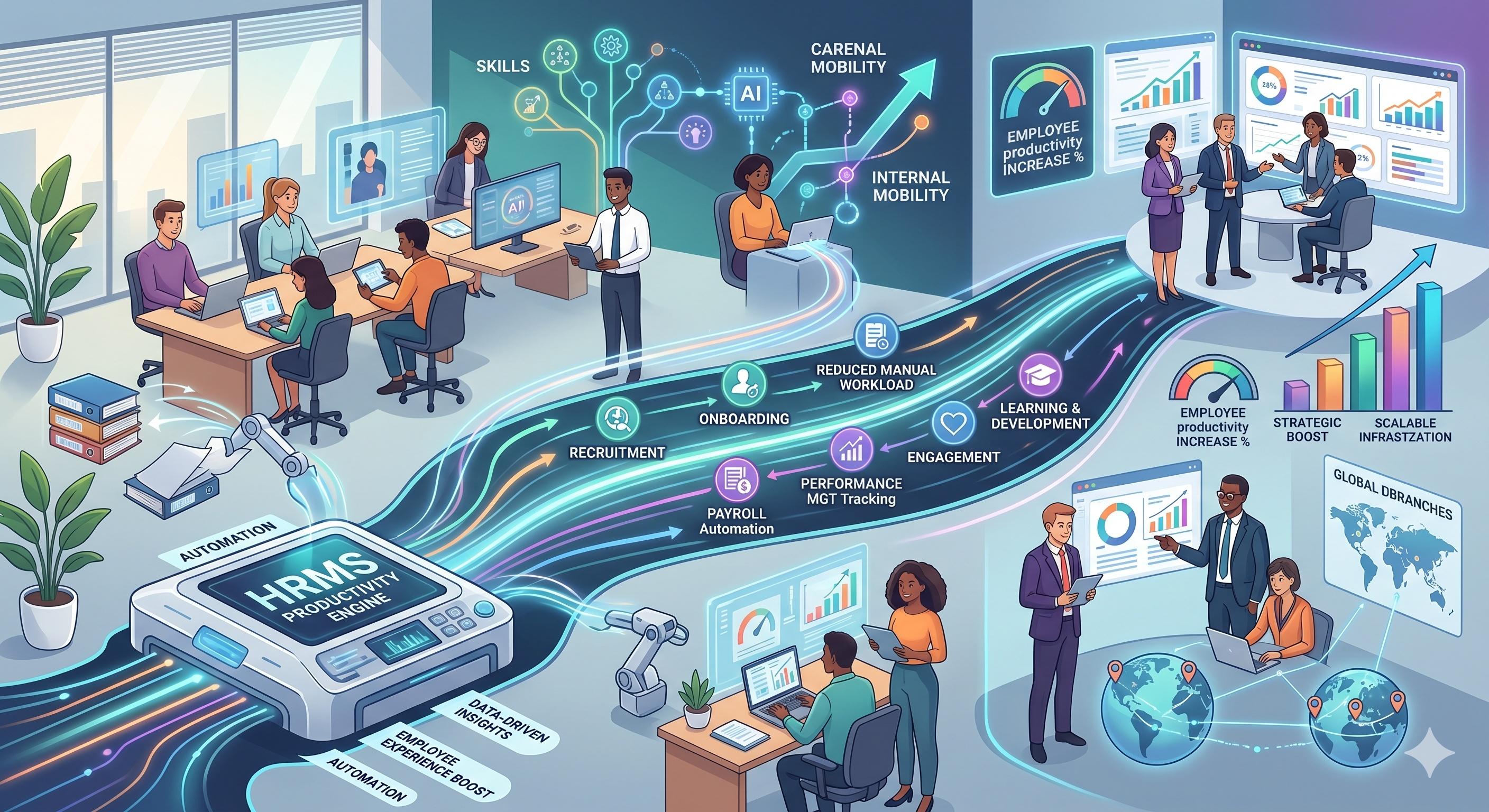
Understanding the HRMS benefits is essential for organizations aiming to unlock workforce potential. A robust Human Resource Management System (HRMS) not only automates routine processes but also transforms how employees work, collaborate, and grow.
TL;DR
HRMS benefits include automation, better decision-making, and improved employee experience
AI-powered HRMS enhances internal mobility and talent optimization
Reduces manual workload, enabling HR teams to focus on strategic initiatives
Improves workforce engagement, performance tracking, and accountability
Drives measurable gains in employee productivity HRMS systems
Enables data-driven leadership decisions for C-suite executives
Scalable HR infrastructure supports growing organizations
What is HRMS and Why It Matters for Productivity
A Human Resource Management System (HRMS) is an integrated software solution designed to manage HR processes such as recruitment, onboarding, payroll, performance management, and employee engagement.
But beyond operational efficiency, the real value lies in its ability to influence productivity.
The key hr software benefits include:
Centralized employee data
Automated workflows
Real-time analytics
Enhanced employee experience
When implemented strategically, HRMS becomes a productivity engine rather than just an administrative tool.
The Direct Link Between HRMS and Employee Productivity
1. Automation Eliminates Time-Consuming Tasks
One of the most impactful HRMS benefits is automation.
Routine HR tasks such as attendance tracking, payroll processing, and leave management consume significant time. By automating these processes, HRMS frees up valuable hours for both HR teams and employees.
As a result:
Employees spend more time on meaningful work
HR teams focus on strategic initiatives
Errors are significantly reduced
This directly improves employee productivity hrms systems are designed to enhance.
2. Improved Employee Experience Drives Performance
Employee experience is a major productivity driver.
A modern HRMS provides:
Self-service portals
Easy access to information
Transparent communication channels
When employees have control over their data and processes, they feel empowered. This leads to higher engagement and better performance outcomes.
Among the most underrated HRMS advantages, improved employee experience has a direct correlation with retention and productivity.
3. Data-Driven Decision Making for Leaders
C-suite executives need actionable insights, not just reports.
HRMS platforms provide:
Workforce analytics
Performance metrics
Predictive insights
With these capabilities, leaders can:
Identify productivity gaps
Optimize workforce allocation
Forecast talent needs
This strategic visibility is one of the most powerful HRMS benefits for modern enterprises.
How AI is Revolutionizing Internal Mobility in Modern Workplaces
The Shift Toward Internal Talent Optimization
Organizations are increasingly focusing on internal mobility as a way to retain talent and reduce hiring costs.
AI-powered HRMS systems play a critical role in this transformation.
They analyze:
Employee skills
Performance data
Career aspirations
This enables intelligent talent matching within the organization.
AI-Driven Skill Mapping and Career Pathing
AI identifies skill gaps and recommends:
Learning opportunities
Career progression paths
Internal job matches
This creates a dynamic workforce where employees continuously evolve.
Such innovation amplifies HRMS benefits, especially in large organizations where manual talent tracking is impossible.
Reducing Attrition Through Smart Mobility
Employees leave organizations when they don’t see growth opportunities.
AI-enabled HRMS solves this by:
Highlighting internal opportunities
Encouraging lateral movement
Supporting career development
This improves retention and ensures sustained productivity.
Key HRMS Features That Enhance Productivity
1. Performance Management Systems
Modern HRMS platforms provide real-time performance tracking.
Features include:
Goal setting (OKRs/KPIs)
Continuous feedback
Performance analytics
These capabilities ensure employees remain aligned with organizational objectives.
2. Attendance and Time Tracking
Accurate time tracking ensures accountability.
HRMS systems eliminate:
Manual attendance errors
Proxy attendance issues
Time theft
This contributes significantly to employee productivity HRMS environments.
3. Payroll Automation
Payroll accuracy directly impacts employee satisfaction.
HRMS ensures:
Timely salary processing
Compliance with regulations
Error-free calculations
Among the practical HR software benefits, payroll automation is one of the most impactful.
4. Employee Self-Service Portals
Self-service portals reduce dependency on HR teams.
Employees can:
Apply for leave
Access payslips
Update personal information
This autonomy enhances efficiency and reduces administrative delays.
5. Learning and Development Integration
Continuous learning is essential for productivity.
HRMS platforms integrate:
Training modules
Skill development programs
Certification tracking
This ensures employees stay relevant and productive.
Strategic HRMS Benefits for C-Suite Leaders
1. Scalability for Growing Organizations
As companies grow, HR complexity increases.
HRMS provides scalable infrastructure to manage:
Expanding workforce
Multi-location teams
Compliance requirements
This scalability is a core component of hrms benefits.
2. Cost Optimization
Automation reduces operational costs by:
Minimizing manual errors
Reducing administrative overhead
Improving resource utilization
These financial gains make HRMS a high-ROI investment.
3. Enhanced Workforce Visibility
HRMS dashboards provide real-time insights into:
Employee performance
Attendance patterns
Attrition trends
This visibility enables proactive decision-making.
The Role of JioHRMS in Driving Productivity
A modern platform like JioHRMS brings together all these capabilities into a unified ecosystem.
Key capabilities include:
AI-powered talent insights
Seamless payroll and compliance management
Advanced analytics dashboards
Mobile-first employee experience
Integrated performance management
Instead of operating in silos, organizations can leverage a connected system that aligns people, processes, and performance.
These integrated capabilities amplify the overall hrms benefits while ensuring measurable productivity improvements.
Common Challenges Without HRMS
Organizations without HRMS often face:
Inefficient manual processes
Lack of data visibility
Poor employee engagement
High error rates
These issues directly impact productivity and growth.
Adopting HRMS eliminates these challenges and provides long-term strategic advantages.
Measuring Productivity Gains with HRMS
To truly understand the impact of HRMS, organizations should track:
Employee output per hour
Time saved through automation
Reduction in HR workload
Employee engagement scores
Retention rates
These metrics highlight the tangible hrms benefits achieved post-implementation.
Future Trends: The Evolution of HRMS
1. AI and Predictive Analytics
Future HRMS platforms will:
Predict employee behavior
Identify burnout risks
Optimize workforce planning
2. Hyper-Personalized Employee Experience
HRMS will provide personalized:
Learning paths
Career recommendations
Engagement strategies
3. Integration with Business Ecosystems
HRMS will become a central hub integrating:
Finance systems
Project management tools
Collaboration platforms
These advancements will further enhance employee productivity HRMS environments.
Best Practices for Implementing HRMS Successfully
To maximize hrms benefits, organizations should:
Align HRMS with business goals
Ensure leadership buy-in
Train employees effectively
Monitor performance metrics
Continuously optimize processes
A strategic approach ensures long-term success.
Conclusion
HRMS is no longer just a support function—it is a strategic enabler of productivity and growth.
From automation to AI-driven insights, the impact of HRMS extends across every level of the organization.
For C-suite leaders, investing in HRMS means:
Better decision-making
Higher employee engagement
Sustainable business growth
The cumulative hrms benefits make it an indispensable tool in the modern workplace.
If you're looking to transform your workforce into a high-performing, data-driven powerhouse, now is the time to rethink your HR strategy.
Explore how JioHRMS can help you unlock the full potential of your people, streamline operations, and drive measurable productivity gains—without complexity.
👉 Start your journey toward smarter HR today.