Common HR Terms Every HR Manager Should Know
Why HR Terms Matter More Than Ever
In today’s fast-evolving business landscape, HR is no longer just a support function it is a strategic powerhouse. For C-suite leaders, understanding HR terms is not optional; it is essential.
From workforce planning to AI-driven talent mobility, HR plays a pivotal role in shaping organizational success. However, without a clear understanding of key HR terminology, decision-making can become fragmented, inefficient, and misaligned.
Moreover, as artificial intelligence reshapes the workplace, traditional HR definitions are evolving. Concepts like internal mobility, talent intelligence, and workforce analytics are becoming central to competitive advantage.
This guide serves as a comprehensive HR glossary tailored for leaders who want clarity, control, and strategic insight.
TL;DR
HR terms form the foundation of strategic workforce decisions
Understanding HR terminology improves communication and compliance
AI is redefining internal mobility through skill mapping and automation
A structured HR glossary enhances leadership clarity and alignment
Modern HRMS platforms like JioHRMS enable data-driven HR practices
Mastering HR definitions leads to better hiring, retention, and productivity
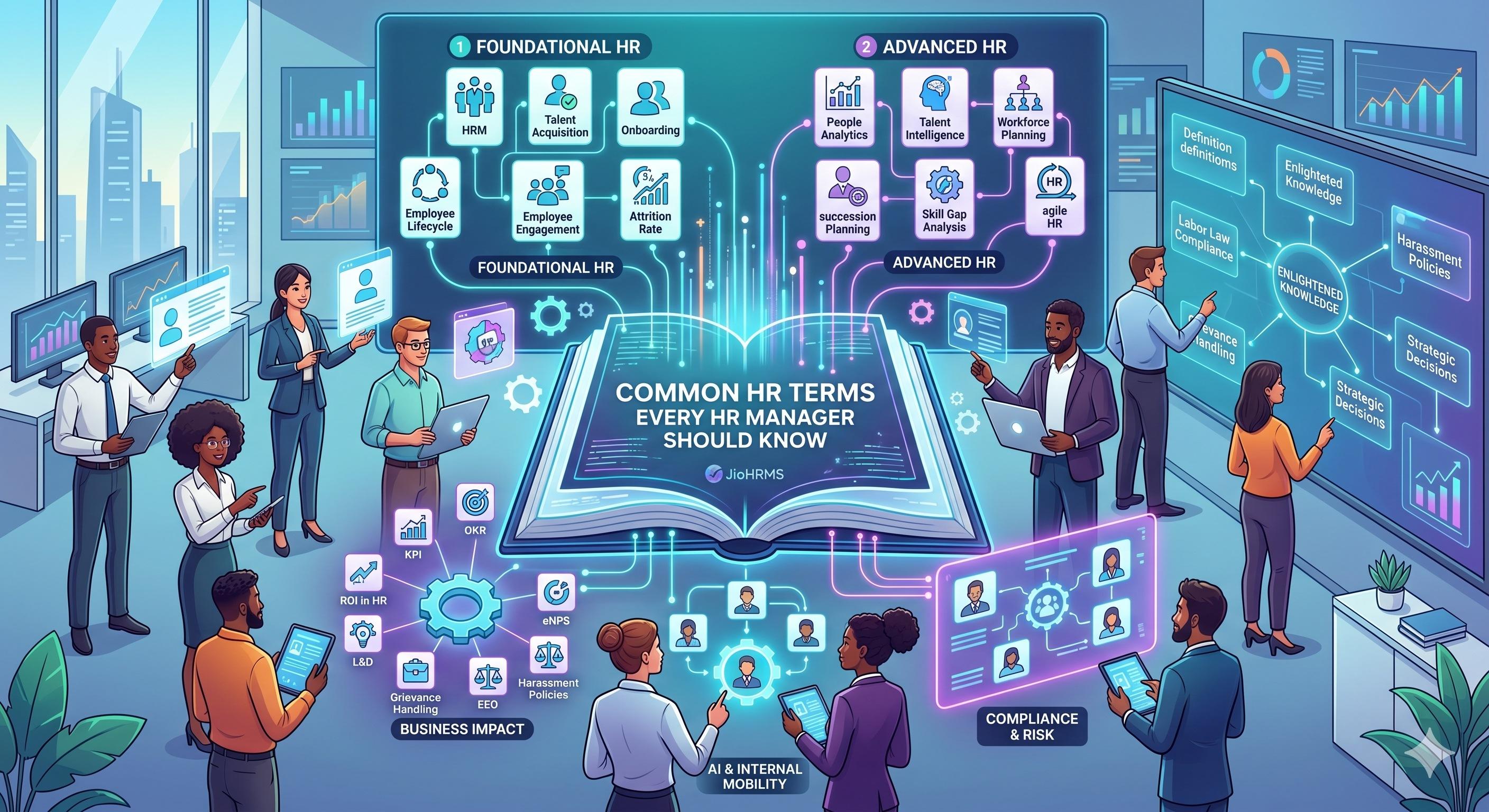
Core HR Terms Every HR Manager Should Know
Understanding foundational HR terms is the first step toward building a high-performing workforce.
1. Human Resource Management (HRM)
The strategic approach to managing people effectively within an organization. It includes recruitment, performance management, and employee engagement.
2. Talent Acquisition
A long-term strategy focused on attracting and hiring top talent, not just filling vacancies.
3. Onboarding
The structured process of integrating new employees into the organization, ensuring productivity from day one.
4. Employee Lifecycle
The complete journey of an employee from recruitment to exit.
5. Performance Management
A continuous process of evaluating and improving employee performance aligned with business goals.
6. Employee Engagement
The emotional commitment employees have toward their organization.
7. Compensation and Benefits
Total rewards offered to employees, including salary, bonuses, and perks.
8. Compliance
Adherence to labor laws, regulations, and organizational policies.
9. Workforce Planning
Forecasting future workforce needs and aligning talent strategy accordingly.
10. Attrition Rate
The percentage of employees leaving an organization over a specific period.
These HR terms form the backbone of every HR strategy. Without clarity here, scaling becomes chaotic.
Advanced HR Terminology for Strategic Leaders
As organizations grow, leaders must move beyond basic HR terminology and embrace advanced concepts.
1. People Analytics
Using data to make informed HR decisions.
2. Talent Intelligence
AI-driven insights into employee skills, performance, and potential.
3. Organizational Development (OD)
Structured efforts to improve organizational effectiveness.
4. Succession Planning
Identifying and developing future leaders within the organization.
5. Total Workforce Management
Managing full-time employees, contractors, and gig workers collectively.
6. Employee Experience (EX)
The overall journey and perception employees have within an organization.
7. Skill Gap Analysis
Identifying gaps between current capabilities and future needs.
8. Agile HR
Adapting HR processes quickly to changing business environments.
These advanced HR terms empower executives to transition from operational HR to strategic HR leadership.
HR Definitions That Drive Business Impact
Understanding HR definitions in context is critical for business outcomes.
1. KPI (Key Performance Indicator)
Metrics used to evaluate success.
2. OKR (Objectives and Key Results)
A goal-setting framework aligning individual and organizational objectives.
3. ROI in HR
Measuring the return on investment for HR initiatives.
4. Employee Net Promoter Score (eNPS)
A metric that measures employee satisfaction and loyalty.
5. Learning and Development (L&D)
Programs aimed at improving employee skills and knowledge.
These HR terms directly influence revenue, productivity, and innovation.
HR Glossary for Compliance and Risk Management
For C-suite leaders, compliance is non-negotiable. A strong understanding of HR terms related to governance is essential.
1. Labor Law Compliance
Adherence to regional employment laws.
2. Equal Employment Opportunity (EEO)
Ensuring fair treatment in hiring and employment.
3. Grievance Handling
Processes to address employee complaints.
4. Code of Conduct
Guidelines defining acceptable behavior.
5. Workplace Harassment Policies
Rules ensuring a safe and respectful environment.
A well-defined HR glossary reduces legal risks and strengthens organizational trust.
How AI Is Revolutionizing Internal Mobility in Modern Workplaces
The future of HR lies at the intersection of technology and talent. AI is fundamentally transforming how organizations approach internal mobility.
1. Skill-Based Talent Matching
AI analyzes employee skills and matches them with internal opportunities, reducing dependency on external hiring.
2. Predictive Career Pathing
AI predicts career trajectories and suggests growth opportunities.
3. Intelligent Workforce Planning
AI forecasts workforce needs based on business trends.
4. Personalized Learning Paths
Employees receive tailored learning recommendations based on skill gaps.
5. Reduced Bias in Promotions
AI-driven decisions minimize unconscious bias, promoting fairness.
These advancements redefine traditional HR terminology by introducing data-driven precision into talent management.
The Role of HRMS in Simplifying HR Terms and Processes
Understanding HR terms is one thing, executing them effectively is another.
This is where modern HRMS platforms like JioHRMS play a critical role.
1. Centralized HR Data
All employee information is stored in one place, improving clarity.
2. Automated Workflows
Processes like onboarding, payroll, and performance reviews are streamlined.
3. Real-Time Analytics
Leaders gain instant insights into workforce trends.
4. AI-Powered Insights
Helps in identifying skill gaps and internal mobility opportunities.
5. Compliance Management
Ensures adherence to labor laws without manual intervention.
By translating complex HR definitions into actionable insights, HRMS platforms enable smarter decision-making.
Why C-Suite Leaders Must Master HR Terminology
For executives, understanding HR terms is not just about HR it’s about business strategy.
1. Better Decision-Making
Clear understanding leads to faster and more accurate decisions.
2. Improved Talent Retention
Strategic HR practices reduce attrition.
3. Enhanced Organizational Alignment
Leaders and HR teams speak the same language.
4. Competitive Advantage
Organizations with strong HR foundations outperform competitors.
5. Future-Ready Workforce
AI-driven HR ensures adaptability in a changing market.
Common Mistakes Leaders Make with HR Terms
Even experienced leaders often misunderstand key HR terms, leading to costly mistakes.
1. Confusing Recruitment with Talent Acquisition
Recruitment is short-term; talent acquisition is strategic.
2. Ignoring Employee Experience
Focusing only on productivity can reduce engagement.
3. Misinterpreting HR Metrics
Using metrics without context leads to poor decisions.
4. Overlooking Internal Mobility
Hiring externally instead of promoting internally increases costs.
Avoiding these pitfalls ensures effective use of HR terminology.
Building a Future-Ready HR Strategy with the Right Terms
To stay competitive, organizations must integrate modern HR terms into their strategy.
1. Adopt AI-Driven HR Practices
Leverage technology for smarter decisions.
2. Focus on Skills, Not Roles
Shift from job-based to skill-based workforce planning.
3. Encourage Internal Mobility
Promote growth within the organization.
4. Invest in Continuous Learning
Upskill employees regularly.
5. Use Data for Decision-Making
Adopt analytics-driven HR strategies.
A strong understanding of HR definitions enables organizations to implement these strategies effectively.
Conclusion
Mastering HR terms is no longer just an HR responsibility, it is a leadership imperative.
As AI continues to redefine internal mobility, organizations that understand and apply modern HR terminology will lead the future of work.
By combining a strong conceptual foundation with advanced tools like HRMS, businesses can unlock unprecedented levels of productivity, engagement, and innovation.
If you're ready to transform your HR strategy from reactive to strategic, it's time to move beyond just understanding HR terms and start applying them with precision.
Discover how JioHRMS can help you:
Simplify complex HR processes
Leverage AI for smarter talent decisions
Enable seamless internal mobility
Drive measurable business outcomes
👉 Book a personalized demo today and build a future-ready workforce with JioHRMS.