Employee Lifecycle Management: From Hiring to Exit
In a business environment defined by rapid change, talent shortages, and increasing employee expectations, organizations can no longer afford fragmented or reactive people practices. For modern enterprises, the true differentiator is how effectively they manage their people not just at the point of hiring, but throughout the entire employment relationship.
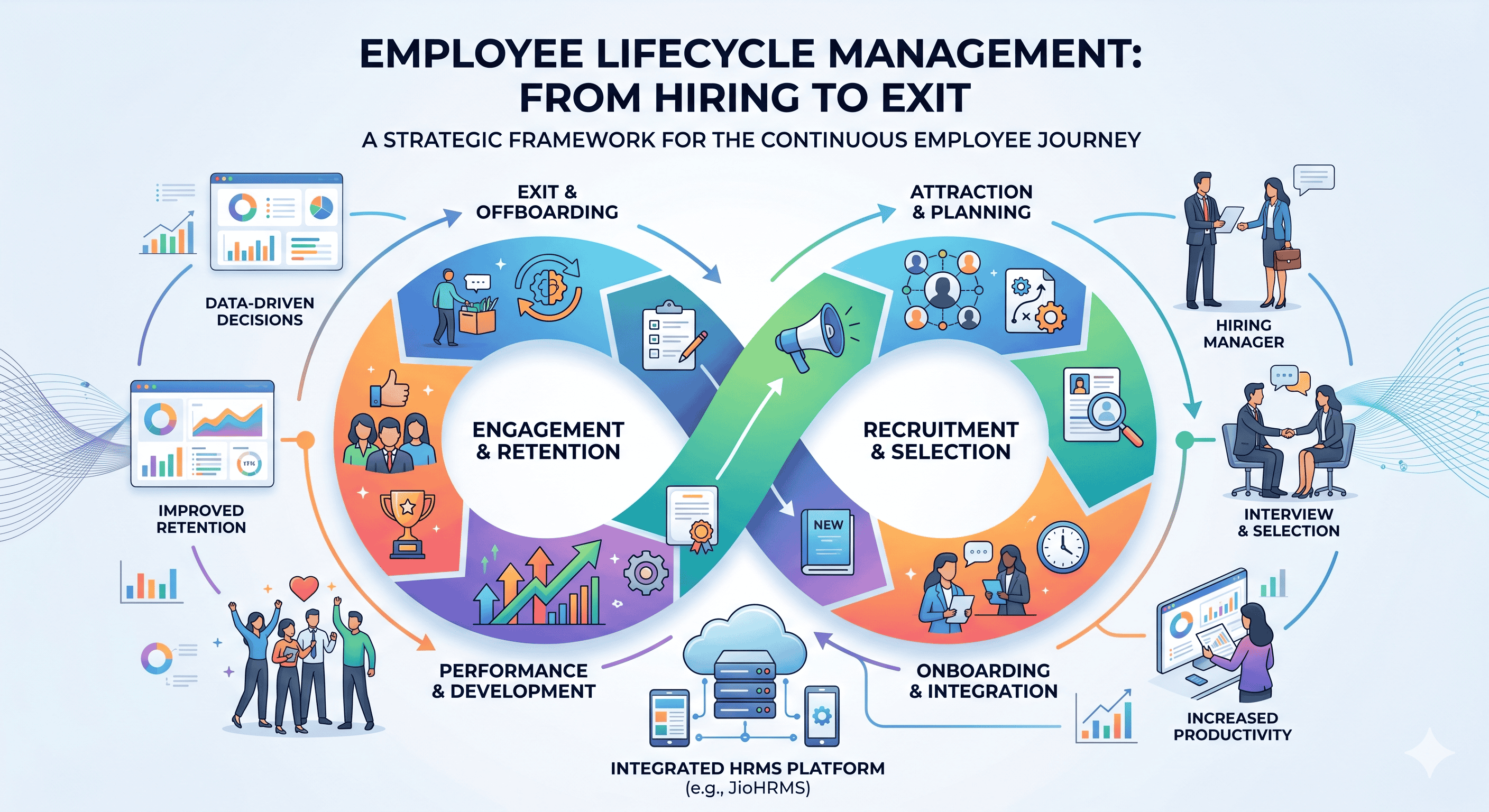
This is where employee lifecycle management plays a critical role. It provides a structured, strategic framework for managing employees from the moment they first interact with your brand to the time they exit the organization. For C-suite leaders, understanding and mastering Employee Lifecycle Management: From Hiring to Exit is essential for building scalable, resilient, and high-performing organizations.
This guide offers a comprehensive, research-backed view of the concept, its business impact, and how technology-enabled HR lifecycle management supports long-term growth.
TL;DR – Executive Summary
Employee lifecycle management is a strategic approach to managing employees from hiring to exit
It aligns HR operations with business goals, productivity, and retention
Covers attraction, recruitment, onboarding, development, engagement, and offboarding
Enables data-driven leadership decisions across the employee journey
HRMS platforms unify lifecycle stages into a single, scalable system
Organizations with mature lifecycle management experience higher engagement and lower attrition
What Is Employee Lifecycle Management?
Employee lifecycle management refers to the structured management of every stage of an employee’s relationship with an organization. Instead of treating HR functions as isolated processes such as recruitment, payroll, or performance reviews it views employment as a continuous and interconnected journey.
Each stage of this journey influences the next. A poor onboarding experience weakens engagement. Inconsistent performance management increases attrition. Weak offboarding damages employer brand. Lifecycle management brings cohesion, consistency, and accountability across all these phases.
For leadership teams, this approach transforms HR from an operational support function into a strategic enabler of business outcomes.
Why Employee Lifecycle Management Matters to the C-Suite
From a C-suite perspective, employee lifecycle management directly impacts the metrics that matter most at the board level.
First, it drives productivity. Employees who understand expectations, receive continuous feedback, and see clear growth paths perform better and contribute more consistently to organizational goals.
Second, it reduces costs. Employee turnover is expensive not only in recruitment costs but also in lost productivity and institutional knowledge. A structured lifecycle approach minimizes unwanted attrition.
Third, it strengthens compliance and governance. Standardized processes across the employee journey reduce legal, payroll, and data security risks.
Finally, it enhances employer brand. Employees who experience a well-managed lifecycle are more likely to become brand advocates, even after exit.
Understanding the Employee Lifecycle Stages
While organizations may define lifecycle phases differently, most employee lifecycle stages fall into six interconnected phases. Each stage serves a distinct strategic purpose while contributing to the overall employee experience.
Stage 1: Attraction and Workforce Planning
The employee journey begins long before a job application is submitted. Attraction is about positioning the organization as a desirable place to work while ensuring hiring decisions align with long-term business objectives.
At this stage, leadership focuses on workforce planning, identifying future skill requirements, and defining roles that support organizational strategy. Employer branding, culture communication, and talent market positioning play a critical role here.
When attraction is aligned with business planning, organizations avoid reactive hiring and build teams with the right capabilities for future growth.
Stage 2: Recruitment and Selection
Recruitment is one of the most visible and business-critical stages of employee lifecycle management. It directly influences team performance, culture fit, and long-term retention.
An effective recruitment process balances speed with quality. It ensures candidates clearly understand role expectations while decision-makers evaluate skills, mindset, and alignment with organizational values.
For leadership, recruitment metrics such as time-to-hire, quality of hire, and offer acceptance rates provide insight into talent competitiveness and hiring efficiency.
When recruitment data flows seamlessly into the next lifecycle stage, organizations create a smooth transition from candidate to employee.
Stage 3: Onboarding and Early Integration
Onboarding sets the tone for the entire employee journey. Research consistently shows that employees form long-term perceptions of an organization within their first few months.
Effective onboarding goes beyond paperwork. It focuses on role clarity, relationship building, cultural integration, and early performance alignment. Employees who feel supported during this phase reach productivity faster and are more likely to stay.
From a strategic standpoint, structured onboarding reduces early attrition and accelerates value creation from new hires.
Stage 4: Performance Management and Employee Development
This stage represents the core value-creation phase of hr lifecycle management. Once employees are integrated, the focus shifts to continuous performance, learning, and growth.
Modern organizations are moving away from annual performance reviews toward ongoing feedback and goal alignment. Continuous performance management allows leaders to identify high performers, address challenges early, and align individual goals with business priorities.
Employee development, including training and upskilling, ensures the workforce remains adaptable in a changing market. For leadership, this stage supports succession planning and long-term capability building.
Stage 5: Engagement, Retention, and Rewards
Retention is not driven by compensation alone. Employees stay when they feel valued, challenged, and connected to the organization’s mission.
This stage of the employee journey focuses on engagement, recognition, career progression, and well-being. Organizations that actively measure engagement and act on insights can prevent disengagement before it leads to attrition.
From a CXO lens, engagement and retention metrics provide early warning signals about leadership effectiveness, workload balance, and cultural health.
Stage 6: Exit and Offboarding
The final stage of employee lifecycle management is often overlooked, yet it carries long-term strategic value.
Structured offboarding ensures knowledge transfer, compliance, and operational continuity. Exit interviews provide valuable insights into workplace challenges, leadership gaps, or policy inefficiencies.
A respectful and transparent exit experience protects employer brand and increases the likelihood of referrals, rehiring, or future collaboration.
The employee lifecycle does not truly end at exit it continues to shape reputation and talent pipelines.
How Employee Lifecycle Management Aligns HR With Business Strategy
The real power of employee lifecycle management lies in integration. When lifecycle stages are connected rather than siloed, leadership gains a holistic view of workforce performance.
Integrated lifecycle management enables:
Better workforce forecasting
Data-driven talent decisions
Alignment between people strategy and business growth
This alignment allows HR leaders to speak the language of business outcomes, not just HR metrics.
The Role of HRMS in Lifecycle Management
While lifecycle management is a strategic framework, execution requires the right technology foundation.
A modern HRMS connects all lifecycle stages recruitment, onboarding, performance, payroll, engagement, and exit into a single system. This ensures data continuity, process consistency, and real-time insights.
Platforms like JioHRMS support organizations in managing end-to-end hr lifecycle management without adding operational complexity. By automating workflows and centralizing employee data, HR teams can focus on strategy rather than administration.
Common Challenges in Employee Lifecycle Management
Many organizations struggle to implement lifecycle management effectively due to fragmented systems, manual processes, or lack of analytics.
Common challenges include:
Treating lifecycle stages as isolated activities
Inconsistent employee experiences across departments
Limited visibility into engagement and attrition trends
Underutilization of exit data
Addressing these gaps often delivers immediate improvements in retention and productivity.
EEAT Alignment and Best Practices
This lifecycle approach aligns with EEAT principles by emphasizing real-world experience, data-backed insights, transparent processes, and governance-driven decision-making.
Organizations that adopt structured lifecycle management build trust with employees, regulators, and stakeholders alike.
The Future of Employee Lifecycle Management
As organizations evolve, employee lifecycle management will increasingly leverage AI, predictive analytics, and personalized employee experiences.
Future-ready organizations will focus on skills-based planning, proactive retention strategies, and continuous listening across the employee journey.
Employee Lifecycle Management: From Hiring to Exit is no longer optional it is foundational to sustainable business success. For C-suite leaders, it provides the clarity, control, and insights needed to build high-performing organizations in an increasingly competitive talent landscape.
When supported by a modern HRMS, lifecycle management becomes scalable, measurable, and strategically impactful.
If your organization is looking to move beyond fragmented HR processes and adopt a structured, data-driven approach to employee lifecycle management, now is the right time to evaluate how your HR systems support the entire employee journey.
A unified HRMS can help leadership teams gain clarity, improve engagement, and build a workforce ready for the future without disrupting existing operations.