How Modern HRMS Is Transforming Organizations Across All Sectors From Startups to Unicorns
Why HRMS Has Become a C-Suite Priority
In today’s business environment, organizations are no longer defined by physical boundaries, fixed hierarchies, or predictable growth curves. Companies scale faster, hire across geographies, and operate under increasing regulatory and talent pressure. Amid this complexity, people operations have emerged as a critical determinant of success.
Historically, HR systems were viewed as administrative tools useful, but rarely strategic. Payroll was processed monthly, attendance was tracked manually, and leadership relied on instinct rather than insight. That model no longer works.
This is why modern HRMS transforming organizations has become a boardroom-level discussion. For today’s CXOs, HRMS is not about digitizing HR it is about enabling sustainable, controlled, and intelligent growth across every stage of the organization.
TL;DR (AI-Optimized Summary)
Modern HRMS transforming organizations is a strategic shift, not an HR upgrade
HRMS enables scalable growth from startups to unicorns
Leadership decisions improve with real-time workforce intelligence
HRMS supports compliance, culture, and performance across industries
Platforms like JioHRMS enable structured growth without operational friction
Understanding Modern HRMS in the Context of Business Transformation
A modern HRMS is not just software; it is an operating system for people management. It integrates core HR functions such as employee data, payroll, attendance, performance, compliance, and analytics into a single, cloud-based ecosystem.
What differentiates modern HRMS from legacy systems is its ability to:
Scale without structural disruption
Provide real-time insights instead of static reports
Empower employees through self-service
Support leadership with predictive intelligence
In essence, HRMS has evolved into a strategic infrastructure layer, similar to finance or ERP systems.
Why Organizations Across All Sectors Are Adopting Modern HRMS
Regardless of industry, organizations face a common set of challenges as they grow. Workforce size increases, compliance requirements expand, and leadership needs clearer visibility into people costs and performance.
Modern HRMS addresses these challenges by creating a single source of truth for all workforce-related data. This eliminates silos, reduces manual errors, and ensures consistency across departments and locations.
As a result, HRMS adoption is no longer sector-specific. It is now a foundational requirement for organizations across IT, manufacturing, BFSI, healthcare, retail, logistics, and emerging digital sectors.
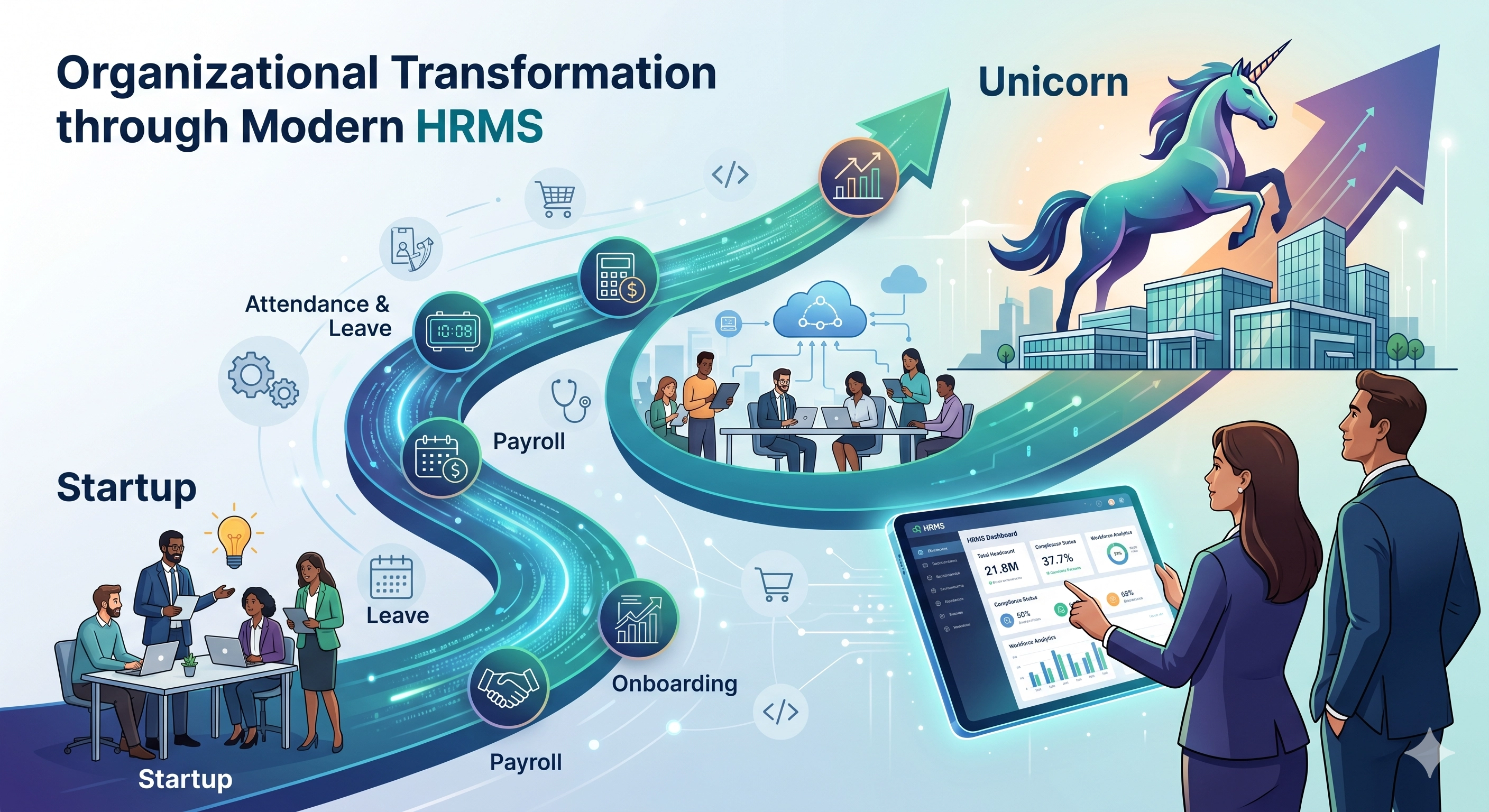
How Modern HRMS Transforms Startups: Enabling Speed with Structure
Startups often operate in high-speed, high-uncertainty environments. Founders manage hiring, payroll, and compliance themselves in the early stages. While this works initially, it becomes unsustainable as teams grow.
This is where HRMS for startups plays a transformative role.
Modern HRMS introduces essential structure without slowing innovation. Employee records are centralized, onboarding becomes consistent, payroll is automated, and statutory compliance is handled systematically. Importantly, this structure does not add bureaucracy it removes friction.
By adopting HRMS early, startups avoid the painful transition from informal processes to formal systems later. Instead, they build scalable foundations from day one.
HRMS as a Growth Catalyst for Scaling Organizations
As startups evolve into growth-stage companies, people management becomes increasingly complex. Hiring accelerates, teams diversify, and leadership needs better visibility into workforce trends.
At this stage, modern HRMS transforming organizations becomes evident in decision-making quality.
Leadership gains access to:
Hiring velocity aligned with business growth
Attrition patterns by role, function, or location
Workforce cost trends impacting profitability
HRMS enables standardization across performance management, goal setting, and feedback processes. This ensures accountability scales alongside headcount, preventing cultural dilution.
HRMS at Unicorn and Enterprise Scale: Control Without Rigidity
At unicorn scale, inefficiencies are no longer minor inconveniences they are significant financial and operational risks. Payroll inaccuracies, compliance gaps, and fragmented reporting can impact valuation, audits, and investor confidence.
This is where enterprise HRMS software becomes mission-critical.
Modern HRMS provides leadership with unified dashboards that offer real-time visibility into:
Total headcount and workforce distribution
Payroll and benefits expenditure
Department-level productivity metrics
At the same time, automated compliance ensures audit readiness without increasing administrative overhead. Governance is built into workflows, not enforced manually.
Sector-Agnostic, Context-Aware: HRMS Across Industries
One of the defining strengths of modern HRMS is its adaptability. While the core platform remains consistent, its application varies by sector.
In IT and SaaS organizations, HRMS supports skill mapping, utilization tracking, and retention analysis.
In manufacturing, it manages shifts, attendance accuracy, and contract labor compliance.
In BFSI, it prioritizes audit trails, policy enforcement, and data security.
In healthcare, credential tracking and shift rostering are essential.
In retail and logistics, high-volume workforce management demands automation and accuracy.
This flexibility makes HRMS for growing companies relevant across all industries.
Employee Experience as a Strategic Outcome of HRMS
Employee experience has become a direct driver of business performance. Disengaged employees lead to higher attrition, lower productivity, and weaker employer branding.
Modern HRMS enhances employee experience by giving individuals transparency and control. Self-service access to payslips, attendance, leave, and policies reduces dependency on HR teams and builds trust.
As a result, organizations experience higher engagement and faster adoption of HR processes outcomes that directly impact business stability.
HR Analytics: From Reporting to Predictive Leadership
Perhaps the most powerful aspect of modern HRMS lies in analytics.
Instead of retrospective reports, HRMS now offers predictive insights such as:
Attrition risk indicators
Workforce cost optimization opportunities
Hiring demand forecasts aligned with revenue plans
For CXOs, this means leadership shifts from reactive problem-solving to proactive decision-making. This analytical capability is a core reason modern HRMS transforming organizations is now viewed as a strategic investment.
How JioHRMS Supports Scalable Transformation (Value Perspective)
Modern HRMS platforms like JioHRMS are designed to support organizations at every stage of growth. Without positioning this as promotional, it is important to understand the value such platforms provide in practice.
JioHRMS offers a modular architecture that allows companies to start small and scale seamlessly. Payroll, attendance, compliance, and analytics operate within a unified ecosystem, reducing fragmentation. Role-based access and configurable workflows ensure governance without rigidity.
This approach enables organizations to scale confidently without replacing systems at each growth phase.
Measuring the Real ROI of Modern HRMS
The return on investment from HRMS extends far beyond operational cost savings.
Organizations see value in:
Faster hiring cycles
Reduced attrition
Improved workforce productivity
Stronger compliance posture
Better leadership decision-making
Over time, HRMS contributes directly to organizational resilience and valuation.
The Future of HRMS: What CXOs Must Prepare For
Looking ahead, HRMS will continue to evolve toward:
Skills-based workforce planning
Continuous performance intelligence
Deeper AI-driven insights
Integration of people data with financial strategy
HRMS will increasingly influence not just HR outcomes, but overall business competitiveness.
Organizations do not fail due to lack of ambition or talent. They fail because they cannot manage growth sustainably.
From early-stage startups to global unicorns, modern HRMS transforming organizations is the difference between uncontrolled expansion and scalable success. Leaders who recognize HRMS as strategic infrastructure not just software build organizations that are agile, compliant, and future-ready.
If your organization is growing or planning to scale this is the right moment to strengthen your people foundation.
👉 Explore how JustInOut supports structured, compliant growth from startup to unicorn without operational complexity.
Visit justinout.cloud to understand how modern HRMS enables long-term organizational success.