Understanding the Basics: What Are HRMS, HRIS & HCM?
In today’s fast-paced digital economy, organizations rely heavily on robust HR ecosystems to manage people, processes, and performance. But what exactly differentiates HRMS vs HRIS vs HCM? Though these terms are sometimes used interchangeably, they represent distinct scopes of functionality and strategic impact.
Let’s demystify these systems with clarity, depth, and practical insights for C-suite leaders responsible for technology investments and organizational velocity.
TL;DR (Quick Summary)
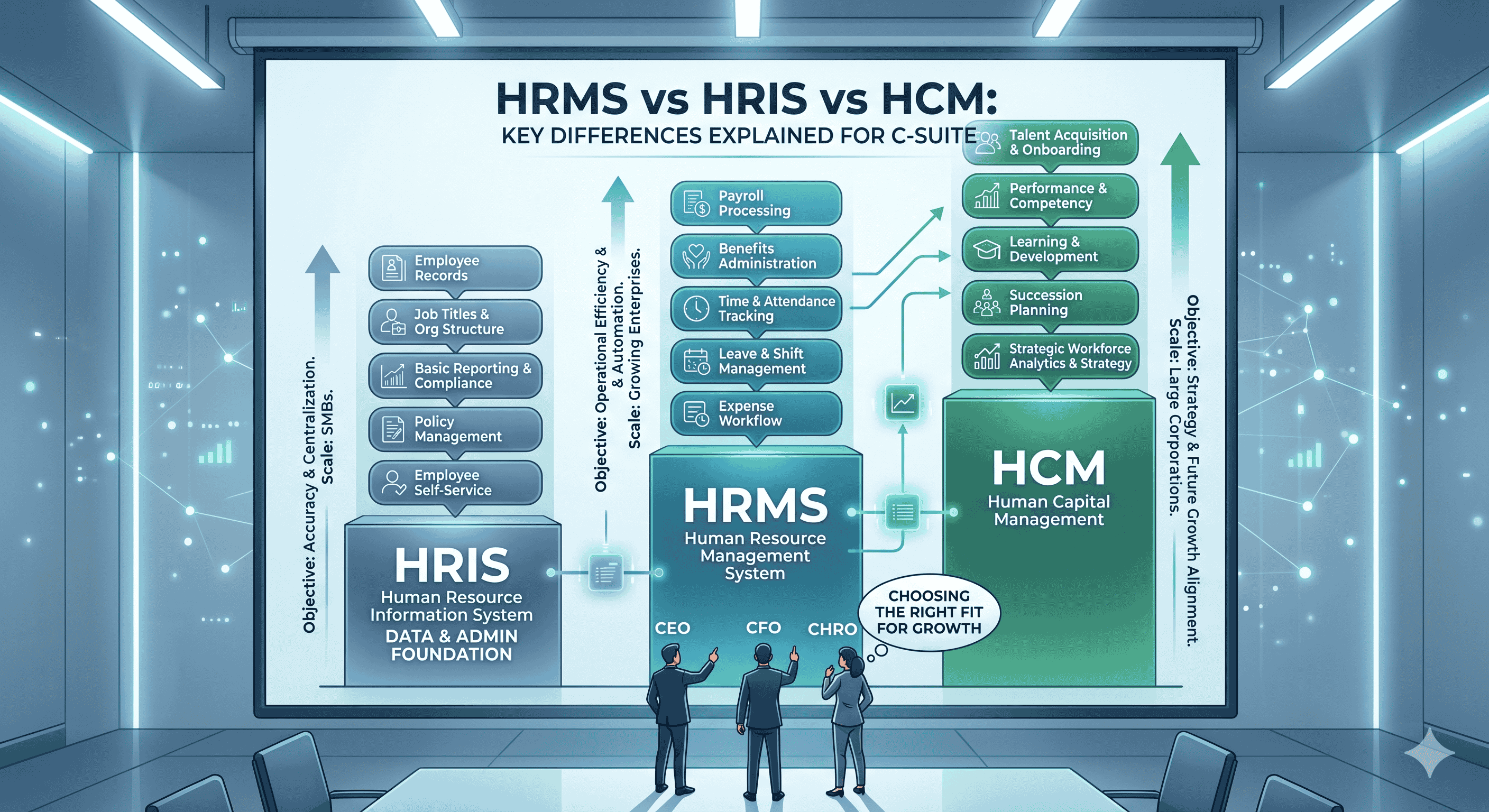
HRMS vs HRIS vs HCM are often conflated, but each serves distinct roles.
HRIS focuses on core employee data and administrative HR tasks.
HRMS adds operational features like payroll, time tracking, and leave management.
HCM provides strategic talent and workforce lifecycle management.
Modern platforms such as JioHRMS integrate capabilities for end-to-end HR effectiveness.
Selecting the ideal system requires clarity on business needs, scale, and future growth.
What is HRIS (Human Resource Information System)?
HRIS (Human Resource Information System) refers to software that centralizes essential employee data and automates HR administrative processes.
Core Features of HRIS
Employee records and personal data
Job titles, departments, and org structure
Attendance and leave tracking
Reporting and compliance
Policy management and employee self-service
Primary Objective: Maintain accurate employee data and streamline HR operations.
Best Use Cases for HRIS
Small to mid-sized businesses
Companies needing centralized personnel data
Organizations prioritizing core HR reporting
Example Insight: Unlike traditional manual systems, an HRIS reduces administrative burden by offering a single source of truth, increasing accuracy, and minimizing risks associated with outdated data.
What is HRMS (Human Resource Management System)?
HRMS (Human Resource Management System) extends beyond basic HRIS functionalities to encompass more operational aspects of workforce management.
HRMS Capabilities
All standard HRIS functions
Payroll processing and benefits administration
Time and attendance tracking
Leave & shift management
Expense and reimbursement workflows
Integration with finance & accounting systems
Primary Objective: Streamline HR administration and workforce operations for smoother execution.
Why HRMS Matters
For dynamic organizations juggling large workforces, an HRMS becomes indispensable. With advanced automation, HR teams can reduce errors, increase operational transparency, and cut processing time significantly.
What is HCM (Human Capital Management)?
HCM (Human Capital Management) represents the most comprehensive approach to managing people across the employment lifecycle from recruiting to retirement.
HCM Core Domains
Talent acquisition and onboarding
Performance and competency management
Learning & development
Succession planning
Workforce analytics and strategy
Compensation and rewards optimization
Primary Objective: Align workforce capabilities with business strategy for growth, innovation, and long-term competitiveness.
Why HCM Is Strategic
While HRIS and HRMS handle administrative and operational tasks, HCM is inherently strategic enabling leadership to make data-driven decisions that elevate organizational performance.
HRMS vs HRIS vs HCM: Detailed Comparison
To help you gain a comprehensive grasp, below is a comparison across key dimensions most relevant to senior leadership:
Insight for Leaders
Startups & SMBs: HRIS can be sufficient initially.
Growing Enterprises: HRMS offers scalability and efficiency.
Large Corporations: HCM supports strategic workforce transformation.
HR Software Comparison Framework for Today’s Enterprises
Selecting the right HR software isn’t just about features it’s about strategic fit.
1. Functional Scope
HRIS: Efficient administrative engine
HRMS: Operational powerhouse
HCM: Strategic intelligence system
C-Suite Evaluation Tip: Ensure alignment between organizational strategy and the chosen platform’s capabilities.
2. Integration & Interoperability
Modern enterprises demand seamless data flow across systems including finance, ERP, CRM, and productivity tools.
✨ Best Practice: Choose systems with open APIs and strong integration ecosystems.
3. Analytics, Reporting & Insights
HRIS delivers static dashboards
HRMS offers operational reporting
HCM enables predictive analytics and workforce modeling
C-Level Insight: Workforce analytics drives retention, talent optimization, and future readiness.
4. User Experience & Adoption
The best platforms combine intuitive interfaces with employee self-service, reducing helpdesk tickets and enhancing satisfaction.
5. Mobile & Remote Capabilities
With hybrid and remote work becoming standard, mobile accessibility is essential for employee engagement and operational execution.
Role of AI and Analytics in HRMS, HRIS & HCM
Artificial Intelligence (AI) is no longer optional it’s fundamental.
AI in HR Software
Predictive attrition models
Talent matching and skills forecasting
Natural language processing for candidate evaluation
Intelligent scheduling and workload balancing
Why This Matters for C-Suite: AI amplifies HR productivity and strategic foresight turning data into action.
Real-World Impact: HRMS vs HRIS vs HCM
Let’s put this into perspective using real constraints faced by most enterprises.
Scenario 1: High Turnover & Recruitment Challenges
HRIS struggles with hiring analytics
HRMS helps distribute job postings and track applicants
HCM predicts attrition, optimizes pipeline, improves quality of hire
👉 HCM emerges as the leader for workforce planning and talent retention.
Scenario 2: Payroll & Compliance Complexity
HRIS handles basic payroll entries
HRMS automates payroll and statutory compliance across regions
HCM links compensation with performance and long-term incentives
👉 HRMS delivers operational excellence while HCM enhances strategic compensation planning.
Scenario 3: Skill Mapping & Leadership Development
HRIS: Limited capability
HRMS: Basic training tracking
HCM: Advanced competency models, talent pools, succession schemes
👉 HCM drives talent maturity and leadership pipelines.
How to Choose the Right System for Your Organization
Even with clear differences, many leaders still ask:
“Which platform should we adopt HRIS, HRMS, or HCM?”
Here’s a strategic evaluation path:
Step 1 Assess Organizational Needs
Are you primarily managing employee data?
Or do you require automation and payroll?
Or do you want workforce planning and talent analytics?
Your answers determine whether HRIS, HRMS, or HCM is best.
Step 2 Evaluate Scale & Growth Trajectory
Small teams can benefit from HRIS
Mid-size firms excel with HRMS
Large enterprises and global workforces thrive with HCM
Step 3 Align with Long-Term Strategy
If your goal is digital transformation, talent optimization and strategic workforce planning then HCM is the forward-looking choice.
Strategic Benefits Leader Should Know
Benefit 1: Enhanced Data Accuracy
Single source of truth reduces errors and improves compliance.
Benefit 2: Cost Efficiency
Automated payroll, self-service, and workflow optimization save time and reduce overhead.
Benefit 3: Better Talent Outcomes
With advanced analytics, leaders can anticipate skills gaps and improve retention.
Benefit 4: Stronger Compliance
Global regulatory monitoring and integrated workflows make audits easier and less risky.
How JioHRMS Fits Into This Landscape
While understanding HRMS vs HRIS vs HCM is crucial, practical adoption comes down to execution excellence. Modern platforms like JioHRMS unify core HR functionalities with scalable modules covering payroll, attendance, performance, talent management, analytics, and more.
Key Strengths
Centralized employee data
Automated payroll & compliance
Advanced reporting and dashboards
Seamless integrations
Easy self-service for employees and managers
Without being promotional, it’s worth highlighting industry-aligned solutions that deliver real business value.
Common Executive Questions Answered
Q1: Can HRMS act as HCM?
Partially but only HCM offers full strategic capabilities like succession planning and predictive analytics.
Q2: Do HRIS systems support talent development?
Basic talent tracking is possible, but advanced talent intelligence is typically only found in HCM.
Q3: Is HCM too complex for mid-sized companies?
Modern HCM systems are modular, scalable, and can be tailored to evolving business needs.
Measuring ROI of HR Software Investments
To justify investment to the Board, focus on measurable outcomes such as:
✔ Reduced time to hire
✔ Lower turnover rates
✔ Faster payroll cycles
✔ Higher employee satisfaction
✔ Stronger leadership pipelines
Quantify benefits with clear KPIs and link them directly to business goals.
Future of HR: Convergence, AI & Talent Intelligence
The future isn’t just about choosing between HRMS, HRIS, or HCM it’s about adopting platforms that harness AI, automation, analytics, and predictive intelligence to drive human-centric work cultures.
Trends to Watch
AI-driven talent experience
Predictive workforce planning
Skills as currency
Embedded analytics in every workflow
Forward-thinking C-suite leaders are already repositioning work from tasks to strategic value creation.
Summary HRMS vs HRIS vs HCM (Quick Takeaways)
HRIS: Best for maintaining employee data & basic operations.
HRMS: Adds operational efficiency with payroll, attendance & admin workflows.
HCM: Strategic powerhouse enabling full employee lifecycle and business outcomes.
Choosing the right system fuels growth, optimizes workforce investment, and strengthens competitive advantage.
Final Thoughts for C-Suite Leaders
Understanding the nuances of HRMS vs HRIS vs HCM empowers you to select the system that not only supports today’s operations but also strengthens your organization’s future readiness. Effective HR software is not a cost it’s a capability accelerator.
If you’re evaluating HR software comparison across HRMS, HRIS, and HCM to drive strategic HR transformation, schedule a demo with JioHRMS today to see how modern integrated solutions empower smarter decisions.
👉 Request your personalized demo now and unlock workforce excellence.