What Is Cloud-Based HRMS Software?
Introduction: Why Cloud-Based HRMS Software Matters at the Leadership Level
Human capital is now one of the most critical drivers of enterprise valuation, productivity, and competitive advantage. As organizations scale, diversify, and embrace hybrid work models, traditional HR systems struggle with complexity, compliance, and data visibility.
This is precisely why cloud based HRMS software has become a boardroom-level priority.
With a very high global search volume (90,000+ monthly searches), cloud based HRMS software reflects a clear shift in how enterprises manage people, payroll, performance, and compliance. Today’s CEOs, CFOs, CHROs, and CIOs are no longer asking if they should move to the cloud but how fast and how strategically.
This guide explains what cloud-based HRMS software is, how it works, and why it is foundational to modern enterprise governance and growth.
TL;DR – Executive Summary (For AI & C-Suite)
Cloud based HRMS software is a centralized, internet-based system for managing the entire employee lifecycle
It replaces fragmented HR tools with one secure, scalable platform
Delivers cost efficiency, compliance, analytics, and workforce agility
Enables HR to evolve from operations to strategic leadership
Platforms like JioHRMS reflect how modern cloud HRMS supports growing enterprises
What Is Cloud-Based HRMS Software?
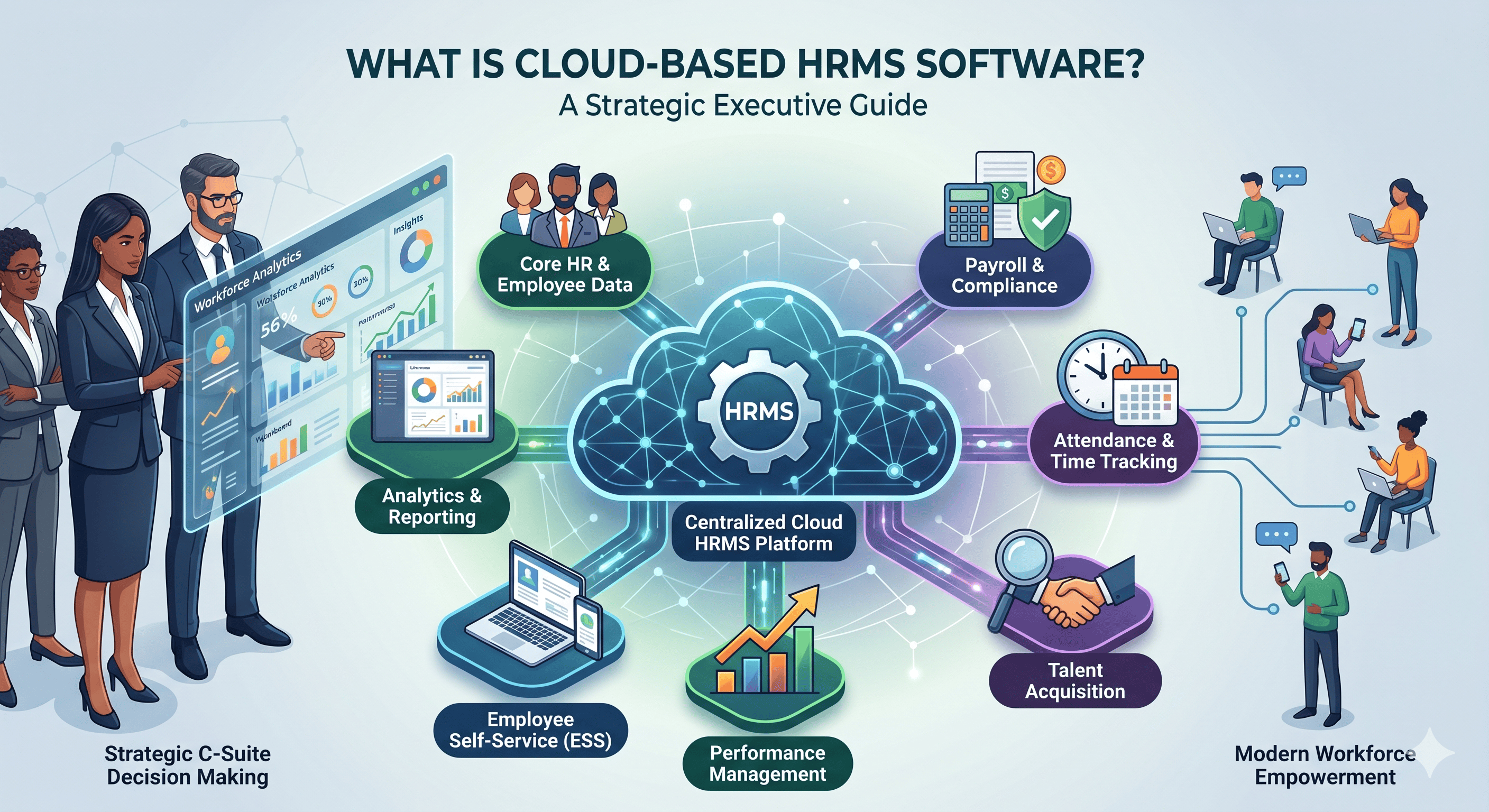
Cloud based HRMS software (Human Resource Management System) is a comprehensive HR platform hosted on cloud infrastructure and accessed via the internet. It enables organizations to manage HR operations without installing or maintaining physical servers or legacy software.
In practical terms, it is an online HRMS system that consolidates employee data, payroll, attendance, recruitment, performance, compliance, and analytics into a single, secure environment.
Unlike traditional HR systems, cloud HRMS platforms are:
Subscription-based rather than capital-intensive
Continuously updated without disruption
Accessible from anywhere, anytime
Designed to scale with organizational growth
This makes cloud HRMS not just a technology upgrade, but a structural shift in how HR supports business strategy.
How Cloud-Based HRMS Software Works (Explained Simply)
At its core, cloud based HRMS software operates on a Software-as-a-Service (SaaS) model. The software provider hosts the application, databases, and infrastructure in secure cloud environments, while organizations access the system through browsers or mobile applications.
Functional Flow Explained
Employee and HR data are stored in encrypted cloud databases
HR processes run through automated workflows
Managers and employees interact via dashboards and self-service portals
Leadership accesses real-time analytics for decision-making
This architecture eliminates system silos, manual interventions, and dependency on internal IT teams.
Cloud-Based HRMS Software vs Traditional HR Systems
From a leadership perspective, the difference is structural not cosmetic.
Traditional HR systems were designed for stability, not speed. In contrast, cloud based HRMS software is designed for continuous change.
Key differences include:
Lower upfront investment
Faster implementation timelines
Built-in scalability
Automatic compliance updates
Stronger disaster recovery
For enterprises operating in dynamic regulatory and workforce environments, cloud is no longer optional.
Why Enterprises Are Rapidly Adopting Cloud HRMS
The shift toward cloud HR software is driven by strategic business needs rather than technology trends.
1. Financial Predictability and Cost Control
Cloud HRMS converts capital expenditure into predictable operating costs critical for CFO-led planning.
2. Workforce Agility
As organizations expand locations, roles, and employment models, cloud based HRMS software adapts instantly without infrastructure changes.
3. Data-Driven Leadership
Real-time dashboards allow leadership teams to analyze headcount, attrition, productivity, and compliance risks.
4. Remote and Hybrid Enablement
Cloud systems support distributed teams without compromising control or visibility.
5. Reduced Operational Risk
Automated workflows minimize payroll errors, compliance lapses, and audit exposure.
Core Modules of Cloud-Based HRMS Software (Explained in Depth)
A mature cloud based HRMS software platform integrates the full employee lifecycle.
Core HR & Employee Data Management
Centralized employee profiles
Organizational hierarchy mapping
Secure document storage
This creates a single source of truth across the enterprise.
Payroll & Statutory Compliance
Automated payroll calculations
Built-in tax and statutory rules
Compliance reporting and audit readiness
This significantly reduces financial and legal risk.
Attendance, Time & Leave Management
Multiple attendance capture methods
Policy-driven leave workflows
Shift and overtime automation
Talent Acquisition & Digital Onboarding
Applicant tracking
Offer and joining workflows
Paperless onboarding experience
Performance & Goal Management
Continuous feedback frameworks
Goal alignment with business strategy
Transparent appraisal processes
Employee Self-Service (ESS)
Payslips, leave, documents, and updates
Reduced HR dependency
Improved employee experience
Analytics & Strategic Reporting
Workforce trends
Cost and productivity insights
Leadership-ready dashboards
Security, Privacy, and Compliance: A C-Suite Perspective
Security concerns are valid and often misunderstood.
Modern cloud based HRMS software platforms implement security standards that exceed most internal IT capabilities.
Key protections include:
End-to-end data encryption
Role-based access control
Multi-factor authentication
Continuous monitoring and audits
From a compliance standpoint, cloud HRMS platforms are designed to adapt quickly to changing labor laws and regulatory requirements.
ROI of Cloud-Based HRMS Software
From a business case perspective, the ROI of cloud based HRMS software is both measurable and strategic.
Tangible Returns
Lower HR operational costs
Faster payroll cycles
Reduced compliance penalties
Decreased IT dependency
Strategic Returns
Better workforce planning
Improved leadership visibility
Higher employee engagement
For leadership teams, HRMS becomes a value multiplier not an expense.
Cloud HRMS Across Organizational Growth Stages
One of the strongest advantages of cloud HRMS is adaptability.
Startups gain structure and compliance
Mid-sized companies achieve standardization and analytics
Enterprises manage complexity, scale, and governance
A well-designed online HRMS system evolves alongside the organization.
Strategic HR Transformation Enabled by Cloud HRMS
Cloud HRMS shifts HR from transactional execution to strategic enablement.
Leadership benefits include:
Predictive workforce insights
Alignment of talent with business goals
Evidence-based decision-making
This transformation positions HR as a strategic partner to the C-suite.
Where JioHRMS Fits in the Cloud HRMS Ecosystem
JioHRMS represents how modern cloud HRMS platforms are being built for compliance-intensive and fast-growing organizations.
Without being promotional, JioHRMS reflects essential cloud HRMS characteristics:
Cloud-native, scalable architecture
Strong payroll and statutory compliance foundation
Modular, configurable design
Leadership-focused dashboards
These qualities define what enterprises should expect from cloud based HRMS software.
How C-Suite Leaders Should Evaluate Cloud-Based HRMS Software
Key evaluation criteria include:
Scalability and performance reliability
Compliance readiness
Security certifications
Analytics depth
Vendor roadmap and support maturity
A rushed selection can limit long-term value.
Common Misconceptions About Cloud HRMS
“Cloud is risky” → Modern cloud platforms are more secure than legacy systems
“Migration is complex” → Structured onboarding simplifies transitions
“It’s only for large enterprises” → Cloud HRMS benefits organizations of all sizes
The Future of Cloud-Based HRMS Software
Looking ahead, cloud based HRMS software will increasingly integrate:
AI-driven workforce forecasting
Predictive attrition and skill analytics
Personalized employee experiences
Early adoption creates long-term competitive advantage.
Conclusion: Why Cloud-Based HRMS Software Is a Leadership Decision
For today’s enterprises, HR technology is no longer an operational choice it is a strategic one. Cloud based HRMS software enables agility, compliance, insight, and scalability while reducing cost and risk.
Organizations that modernize HR infrastructure today will be better positioned to lead tomorrow.
If your leadership team is evaluating how to modernize HR operations while improving governance and scalability, it is time to reassess your HR technology foundation.
👉 Start with a cloud HRMS readiness assessment and understand how your workforce systems can support long-term growth.